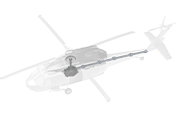


This document aims to assist design engineers in understanding how to effectively protect equipment and reduce damage caused by shock and vibration.
With increasingly sophisticated equipment and harsher operating environments, engineers are facing higher and higher requirements for vibration reduction and shock isolation. Electronic devices often need to operate in environments that exceed the original design specifications. Even if the equipment passes the initial vibration test, without proper protection, its service life and operational reliability will still be significantly reduced.
Equipment installed on aircraft, vehicles, ships, and the like often needs to withstand severe impact loads. Simply strengthening the equipment structure to enhance its impact resistance often leads to increased weight, volume, and cost of the equipment. In contrast, the reasonable selection of shock absorbers is usually a more effective protective solution.
This document introduces the basic principles and application methods of vibration reduction and impact resistance, aiding engineers in analyzing various vibration and impact protection needs. At the initial design stage, by clarifying key parameters, the required type of vibration isolation installation system can be quickly determined, providing a basis for subsequent design and scheme selection.
If standard catalog products cannot meet specific needs, we can also rely on our professional engineering and technical team and comprehensive design and development facilities to tailor solutions for customers, meeting the vibration reduction and impact resistance requirements of different equipment.
VE25-100 is a medium-to-short-range commercial passenger and cargo eVTOL aircraft developed by Shanghai Volante Aviation Technology Co., Ltd. It adopts a compound wing architecture design and is equipped with a full-state control system, enabling simplified operations with longitudinal lever control for altitude adjustment and lateral lever control for steering. The power system supports a range of 200-400 kilometers, meeting the medium-to-short-distance transportation needs between urban clusters with a single charge. The passenger cabin has a volume of 2.3 cubic meters and supports rapid switching between stretcher placement and cargo configuration. The aircraft has a cruise speed of 235 kilometers per hour, with a passenger cabin layout accommodating one pilot and five passengers or a commercial payload of 500 kilograms. It can be applied to medium-to-short-distance commuting, business travel, emergency rescue, aviation logistics, and other fields in cities and inter-city areas. In the future, this aircraft model will undergo a series of test flights to ensure safety and superior performance for future mass production.
VE25-100 is a medium-to-short-range commercial passenger and cargo eVTOL aircraft developed by Shanghai Volante Aviation Technology Co., Ltd. It adopts a compound wing architecture design and is equipped with a full-state control system, enabling simplified operations with longitudinal lever control for altitude adjustment and lateral lever control for steering. The power system supports a range of 200-400 kilometers, meeting the medium-to-short-distance transportation needs between urban clusters with a single charge. The passenger cabin has a volume of 2.3 cubic meters and supports rapid switching between stretcher placement and cargo configuration. The aircraft has a cruise speed of 235 kilometers per hour, with a passenger cabin layout accommodating one pilot and five passengers or a commercial payload of 500 kilograms. It can be applied to medium-to-short-distance commuting, business travel, emergency rescue, aviation logistics, and other fields in cities and inter-city areas. In the future, this aircraft model will undergo a series of test flights to ensure safety and superior performance for future mass production.
VE25-100 is a medium-to-short-range commercial passenger and cargo eVTOL aircraft developed by Shanghai Volante Aviation Technology Co., Ltd. It adopts a compound wing architecture design and is equipped with a full-state control system, enabling simplified operations with longitudinal lever control for altitude adjustment and lateral lever control for steering. The power system supports a range of 200-400 kilometers, meeting the medium-to-short-distance transportation needs between urban clusters with a single charge. The passenger cabin has a volume of 2.3 cubic meters and supports rapid switching between stretcher placement and cargo configuration. The aircraft has a cruise speed of 235 kilometers per hour, with a passenger cabin layout accommodating one pilot and five passengers or a commercial payload of 500 kilograms. It can be applied to medium-to-short-distance commuting, business travel, emergency rescue, aviation logistics, and other fields in cities and inter-city areas. In the future, this aircraft model will undergo a series of test flights to ensure safety and superior performance for future mass production.