
2026.08.31
The Invisible Guardian of Space: Decoding Space-Grade Silicone Rubber
More



Beluga Airlines W5000 Large Unmanned Cargo Aircraft
Completes Technical Verification Test Flight
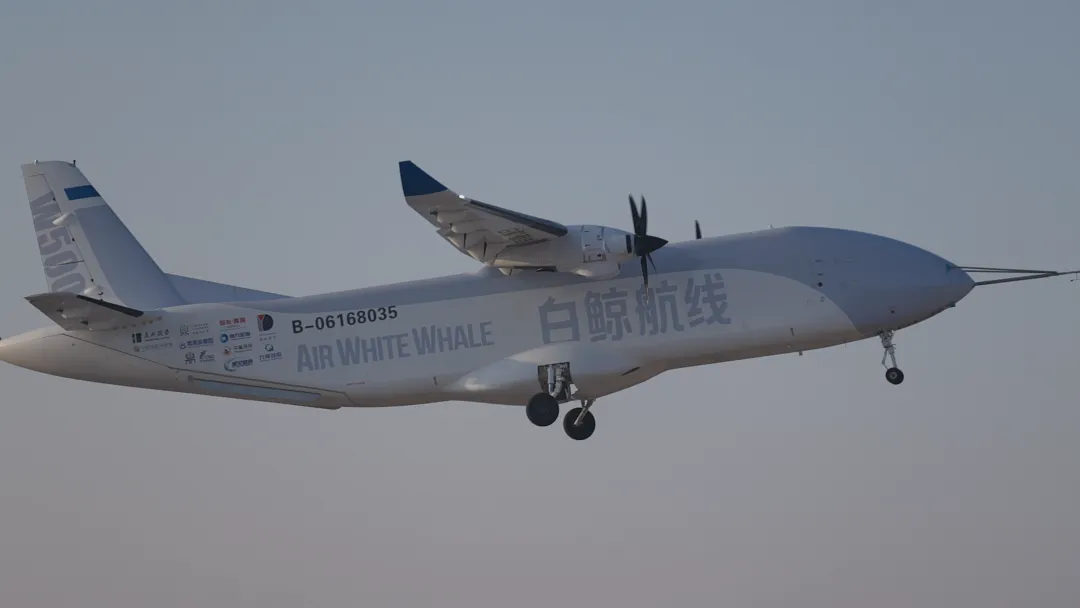
(Image from Beluga Airlines' official WeChat account)
On the morning of November 14, 2026, the Beluga Airlines W5000 large unmanned cargo aircraft successfully completed a technical verification test flight in Otog Front Banner, Ordos, Inner Mongolia. Following the established plan, the aircraft completed climb, level flight, turning, descent and approach-and-landing maneuvers, with the power, flight control, avionics and ground telemetry, tracking and control support systems operating in coordination, verifying its handling stability.
As a supplier to this aircraft, ZT Technology extends its congratulations to Beluga Airlines and to all the teams involved in the test flight!
Each of the W5000's left and right wings carries an AEP100 turboprop aircraft engine independently developed by the Aero Engine Corporation of China (AECC), and the vibration isolation system between the engine and the airframe is provided by Beijing Zhitian Xinhang Technology Co., Ltd. (ZT Technology), with deliveries including vibration isolators and related vibration isolation technical support. On October 18, 2024, when the Beluga Airlines W5000 large unmanned cargo aircraft rolled off the final assembly line in Changzhou, this vibration isolation system, tailor-made for the model, was already installed in the engine nacelle. Today, this product has entered the flight verification stage along with the complete aircraft.
According to Beluga Airlines, the W5000 has a payload of 5 tons, a cargo hold volume exceeding 65 cubic meters and a maximum range of 2,600 kilometers, with composite materials accounting for 65% of the airframe; it operates through autonomous piloting with ground monitoring. This technical verification test flight provides support for advancing the model's subsequent development and verification work.
Meeting Powerplant Requirements and Reducing Vibration Transmission
During operation of a turboprop aircraft engine, the rotation of the rotor, reduction gears and propeller generates vibration at multiple frequencies, which is transmitted along the mounting structure to the nacelle and airframe. A long-term vibration environment places demands on the operational stability of onboard equipment, the reliability of structural connections and service life.
The vibration isolation system is installed at the interface between the engine and the airframe, with the vibration isolator as its core component. Its primary function is to reduce the transmission of vibration to the airframe and related equipment, supporting the stable operation of flight control, avionics, sensors and telemetry, tracking and control equipment. For an autonomously piloted unmanned cargo aircraft, vibration control is an important element in ensuring whole-aircraft reliability.
From Material R&D to Structural Design,
Customizing the Vibration Isolation System to Engine Characteristics
To address the AEP100 aircraft engine's vibration characteristics and installation requirements, ZT Technology started with elastomer material R&D and vibration isolator structural design, conducting research around long service life, damping performance in high-temperature environments and creep control, and using nonlinear elastomer simulation to analyze the mechanical behavior of the product under actual loads, thereby enhancing the ability of the vibration isolator to maintain stable performance under high temperature, sustained loads and long-term use.
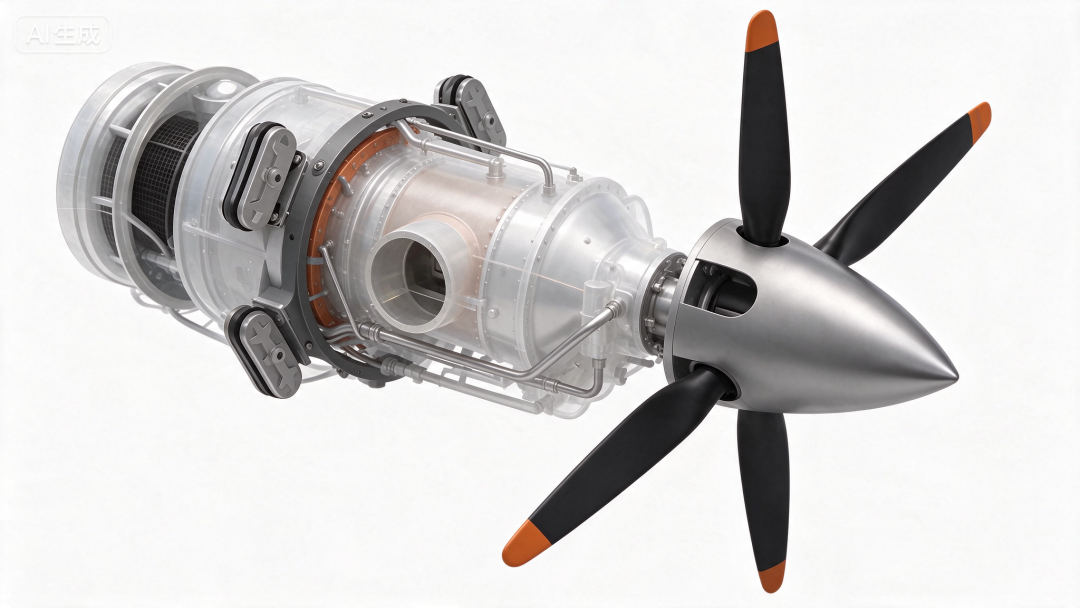
(Schematic diagram of turboprop aircraft engine vibration isolator installation)
In the material R&D stage, the project used big-data models to improve the accuracy of molecular dynamics simulations, providing guidance for the molecular chain design of elastomer materials. By studying the relationship between molecular chain structure and material properties such as damping, temperature resistance and service life, a basis was provided for optimizing material formulations. The material performance parameters were then applied to vibration isolator structural design and simulation analysis, and the product was continuously improved in combination with manufacturing and test verification results.
ZT Technology specializes in aircraft engine vibration isolation and damping components, while also providing vibration damping and shock resistance solutions, forming an R&D and manufacturing process covering material R&D, structural design, simulation analysis, product manufacturing and test verification.
Relying on its self-developed specialty rubber materials, the company has developed dedicated vibration isolation systems for domestically produced aircraft engines such as the AES100 turboshaft and AEP100 turboprop, and has applied accumulated material parameters and nonlinear elastomer simulation to model development.
ZT Technology
The successful technical verification test flight of the W5000 is the result of the collaborative efforts of the aircraft development and flight test teams, and also marks a new verification stage for the aircraft engine vibration isolation system supplied by ZT Technology.
Going forward, ZT Technology will continue to carry out product verification and improvement in line with the model's flight test plan and actual operating conditions, providing supporting technical assistance for whole-aircraft vibration control, reliable operation and airworthiness certification.
The steady progress of every supporting link contributes to the accumulation of independent innovation capability for domestically produced aviation equipment. ZT Technology will continue to deepen its focus on the field of aviation powerplant vibration isolation, working in collaboration with airframe manufacturers and industry chain partners to enhance the independent supporting capability of domestic aviation equipment and expand the applications of unmanned aerial cargo transport.
Author: Han Bing


Click the blue text to follow us
ZT Technology